
Houston County Projected vs Actual Release
A projected date is an estimate or computed endpoint based on the record available now. An actual release date records what happened. Houston County's jail portal can display a release timestamp after a local custody event, but it does not calculate a future state-prison term. A person awaiting trial usually has no certain release day. Bond may be posted, a judge may change the order, or another agency may keep a hold in place.
Georgia state records add two other concepts. A maximum release date, often called an MRD, reflects the sentence calculation subject to law and credits. A tentative parole month, or TPM, marks a month for Board review and possible setting of parole release. It is not a promise. The actual day may be later, earlier, or may never arise from that TPM.
Find Houston County Projected Release
Start by classifying custody. The Houston County Detention Center holds pretrial detainees, some misdemeanor post-trial inmates serving up to one year, and felony post-trial inmates waiting for GDC to receive them. Those groups do not share one date formula. The county inmate portal and court case explain local status. The GDC Find an Offender search covers state custody.
- Check the county portal for current custody or a posted local release date.
- Read the Houston County court case for bond, sentence, transfer, or later order.
- If sentenced to GDC, search by name, GDC ID, or case number and compare identifying details.
- For possible parole, use the Board's TPM Lookup and remember that TPM is tentative.
- After parole begins, use Parolee Search and DCS records for the supervision dates.
- If the public fields conflict, request the sentence, GDC calculation, or agency release record.
The Houston County release-record paths help confirm an event that already occurred. A future estimate requires the system currently responsible for custody.
Georgia Credits and Houston Release Dates
Georgia does not apply one blanket 85-percent rule to every Houston County sentence. The result depends on the offense, sentence, eligibility rules, conduct, credits, and Board decision. O.C.G.A. § 42-5-101 authorizes work incentive credits. GDC's Performance Incentive Credit program says eligible offenders can earn up to 12 points, with a possible one-to-twelve-month reduction to a TPM or MRD through satisfactory programs, work, and conduct.
Credits are not automatic for every person. Georgia work-credit rules also describe credit for satisfactory participation in approved activity. Serious violent felony restrictions under O.C.G.A. § 17-10-6.1 can sharply limit early release. General parole eligibility under O.C.G.A. § 42-9-45 also has exceptions. Eligibility only opens consideration; it does not set the release date.
A county jail date is different. Bond, sentence served, court orders, holds, transfers, and local processing drive that event. Applying a state-prison credit formula to a Houston County pretrial booking produces a false answer.
Why Houston Release Dates Change
A projected release moves when one of its inputs changes. The record should identify the type of date before anyone compares old and new values.
| Factor | Possible effect | Source to verify |
|---|---|---|
| Bond or court order | Creates, delays, or cancels a local release | Houston County court and jail |
| Detainer or agency hold | Turns local release into transfer or continued custody | Holding agency and court |
| GDC credit or discipline | May move an eligible MRD or TPM | GDC calculation |
| Parole review | May set, postpone, deny, or cancel tentative timing | State Parole Board |
| New sentence or correction | Changes the controlling term | Sentencing order and GDC |
| Program condition | May affect final parole setting | Board decision notice |
Misconduct may postpone or cancel parole under the Board's decision guidance. A pending case, warrant, or hold can also prevent community release even when one agency closes its custody event.
Confirm Houston County Release Timing
Georgia VINE can send a custody-change or release alert when the participating agency feed supports it. Register while the person is still in custody and use the VINELink Inmate Search as an alert layer. It is not a sentence calculator. For an urgent local question, call the Houston County Detention Center at (478) 218-4900. Older records can be requested from Sheriff's Records at (478) 542-2130.
For a state prisoner, verify the GDC record and Board status. For probation or a split sentence, pair the court sentence with DCS. If a federal system is involved, use BOP or ICE rather than a Georgia estimate. Each system can close its own custody while another continues.
Houston Release May Mean Transfer
Houston County has an important local date quirk. The Detention Center states that felony post-trial inmates may remain there until GDC can receive them. The county portal can then record the end of county custody when the person is transferred. That date is not necessarily the day the person returns to the community.
Check the hold detail and court sentence when a local release date follows a felony case. Then search GDC. A state record showing an active facility means custody continued. If parole is possible later, the TPM and final Board action belong to that later stage. This transfer chain explains why a county timestamp and a state release estimate can both be accurate while describing different events.
The Houston County Detention Center description establishes the transfer role. GDC's offender search should settle where state custody went next.
Resolve Houston Release Conflicts
When dates disagree, compare records in custody order. Start with the sentencing order for the legal term. Use the GDC record for state calculation and actual state custody. Use the Parole Board record for tentative and final parole decisions. Use DCS for supervision after release. The county portal remains the source for the local jail exit.
A date without a label is not enough. Ask whether it is a bond date, county release timestamp, transfer date, maximum release date, tentative parole month, parole begin date, or supervision end date. Saving that label with the source prevents the most common Houston County release-date error.
Official records can lag after a same-day move. Recheck the relevant system and contact the owning agency if the answer affects a court filing, travel plan, or scheduled pickup. Do not convert a projection into a claim that release occurred.
Houston Projected Release Credits
GDC's Performance Incentive Credit page is the official starting point for understanding how eligible progress may affect a state date.
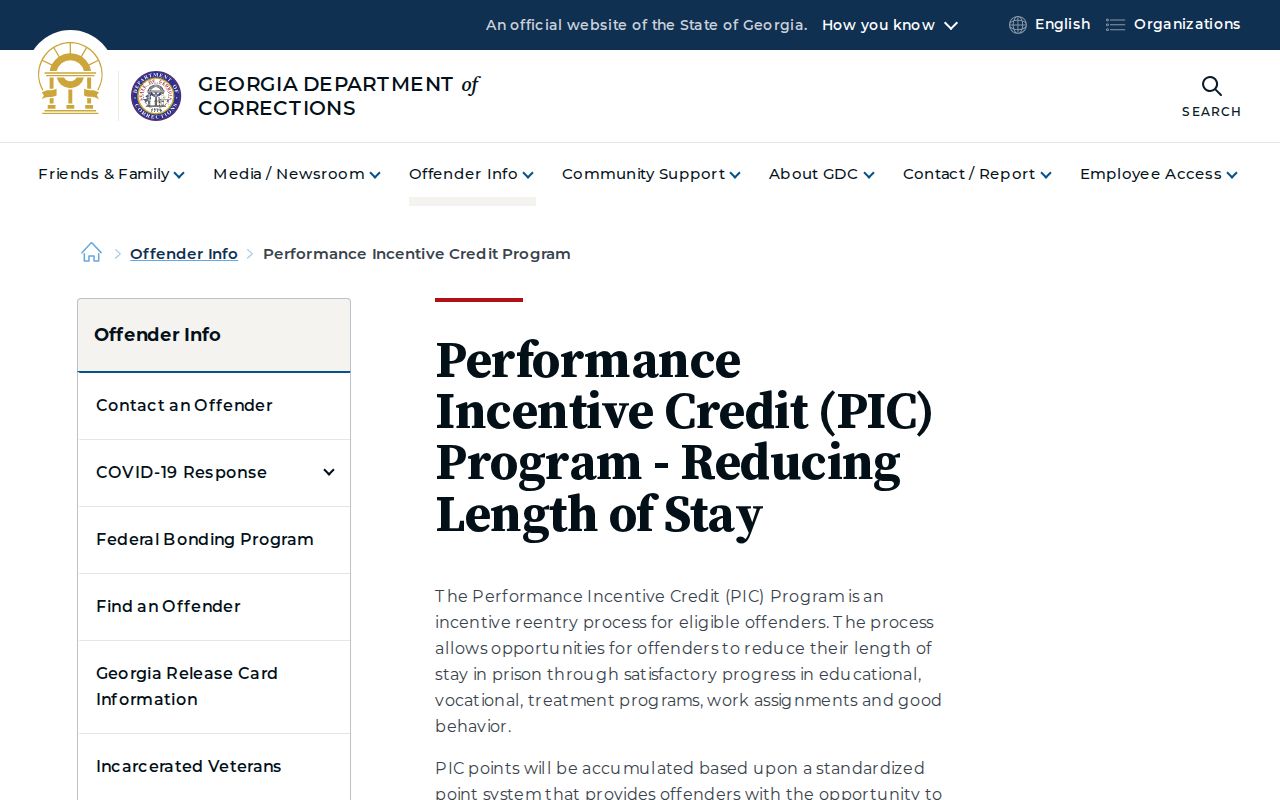
The image supports the statewide rules, but it cannot calculate one person's date without the official GDC record.
PIC points can potentially reduce a TPM or maximum release date by one to twelve months for eligible people. That range is not a promise. Eligibility, work or programming, conduct, offense restrictions, and the official calculation all matter. Do not subtract the maximum possible credit from a sentence and announce a release day.
Ask which date the credit affected. A TPM remains tentative after adjustment. An MRD is a different field. An actual release date appears only after custody ends.
Houston Jail Dates Need Court Records
Local pretrial custody often turns on a court event. A bond can be set but not posted. A judge can impose conditions. A warrant from another county can remain active. Release processing may continue after an order arrives. A predicted pickup time based on one docket entry can therefore be wrong.
Houston County Benchmark searches include several criminal divisions and identifiers. When portal hold text includes a warrant number or Code section, use it to find the case. Read the latest order. The portal then confirms whether the jail recorded an actual exit.
A misdemeanor post-trial inmate may serve a local term, while a felony post-trial inmate may await GDC intake. Ask which status applies. The same Houston County jail event can end in community release, court movement, or state transfer.
Houston Parole Eligibility Is Not Release
General Georgia parole eligibility can begin after a statutory minimum, but exceptions are central. Misdemeanor eligibility is generally after six months or one-third of the sentence, whichever is greater. Felony eligibility is generally after nine months or one-third, whichever is greater, subject to serious violent felony, recidivist, and other restrictions. These rules describe when review may occur, not when release must happen.
The Board can set a later TPM under its guidelines. Conduct and required programs can remain conditions. For a Houston County conviction, use the exact offense and sentence rather than a rule of thumb.
If the Board record says denied or maxed, the GDC maximum date becomes more important. If parole starts, Parolee Search should show begin and end information. DCS then handles local supervision.
Keep a simple date log during a Houston County release check. Note the county release timestamp, GDC maximum date, TPM, parole begin date, and supervision end date in separate rows with their sources. Never merge them into one field. Recheck shortly before any planned pickup because a court hold, transfer, or final review can change the outcome. When an agency gives a verbal answer, ask which record and date type it used. A precise label is more useful than an unsupported promise.
Older release questions may require records requests. Give the person's full name, identifying details, booking or GDC number, conviction county, facility, and the exact date field sought. Narrow requests help the custodian find the correct calculation or transfer record. Protected parts may be withheld, but the response can still identify which agency holds the controlling record.
A release-date request should distinguish calculation records from movement records. The calculation explains how GDC or the court arrived at a date. A movement record shows transfer, release, or receipt by another facility. Houston County portal data may supply only the local movement. GDC can hold the later state calculation. Asking for both avoids an incomplete answer.
Also check whether the person has more than one active case. Concurrent sentences run together, while consecutive sentences run one after another. The research does not support estimating either arrangement from a charge list alone. Obtain the signed sentence and current agency computation. If a clerical error is suspected, direct it to the court or corrections records office with the case number and source document.
Finally, separate eligibility from authority. A statute may make review possible, but the court, GDC, or Parole Board still controls the record at its stage. Houston County jail staff cannot finalize a state parole date, and a public TPM screen cannot override a later Board decision.